

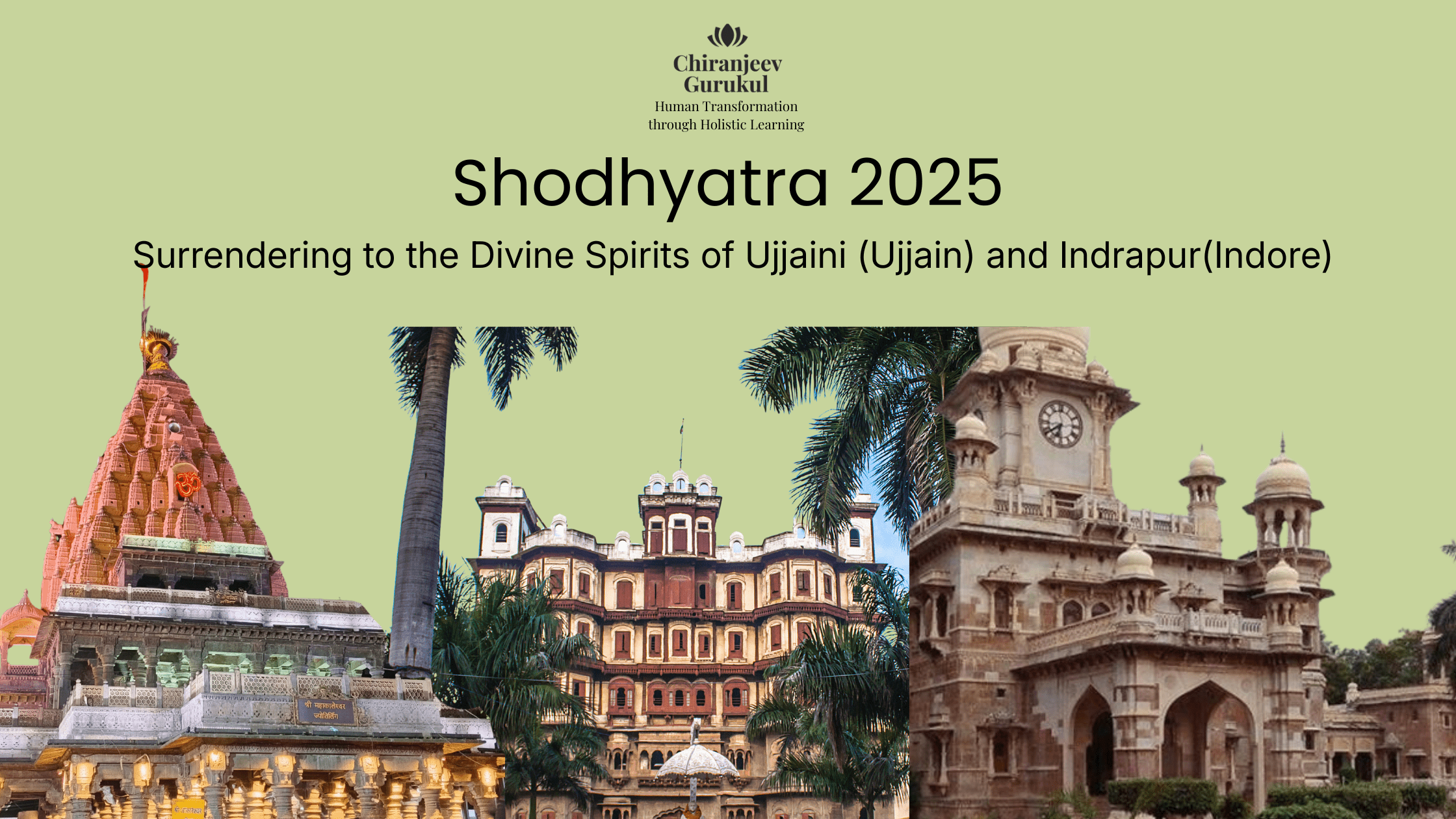
ShodhYatra 2025: Surrendering to the Divine Spirits of Ujjaini (Ujjain) and Indrapur(Indore)
The Significance of राम – The Essence of Self Revelation
Together, LPSG and CG strive to use eternal Indian wisdom as a tool to bring powerful social change in business, education and communities. One of the ways to do that is to study contemporary/ ongoing cases of transformation at the grass roots, in a structured way, and crystallize and disseminate the principles and practices which brought about the change with a Bhaaratiya lens. The discovery of these principles, practices and processes which catalyses the change is the “Shodh” and the investigative journey which brings this to light is the “Yatra”, thus the coining of the phrase “Shodhyatra”.
Five Shodhyatras have been organized since 2017, uncovering Leadership in villages, communities, organizations, immaterial of formal education and organization.
The sixth Shodhyatra, of Indore, was preceded by a visit to the famed ancient city of Ujjain. But what began as a search for a story of transformation triggered a transformation of self. Read on for more…
Samay to Kaal
The Jantar Mantar at Ujjain is not a monument, but has a phenomenal connection to the eternal scientific tradition of Bhaarat itself. Jantar is actually an alternate form of Yantra (mechanism) and this creation of Maharaja Jai Singh II is not merely a collection of thirteen instruments. It reminds us of the mastery of Bhaarat over Astronomy or Jyotish shaastr, wrongly interpreted as Astrology, which is but a subset of the holistic science. These instruments could not only measure “samay” or temporal time, but constituted a Vedh-shaala that studied relationships between celestial bodies as also with terrestrial ones. However, this was raised to an all-new level with the true and deep meanings of Kaal and Mahakaal, the latter being represented by Shiv Bhagwaan. It takes time (pun unintended) and cerebral effort to grasp the fact that ancient Bhaartiya personified and storified all scientific principles to make them accessible, comprehensible and user-friendly. The visit to Mahakaaleshwar temple and its equally scenic corridor combined this irresistable combination of science and spirituality for us
Chronos to Kairos
While the Greek word Chronos alludes to the quantitative aspect of time, Kairos alludes to the qualitative aspect of time. That is what Ujjaini did to us – rather than making us count every minute spent, it made every single moment count by taking us from Jantar Mantar and Mahakeshwar temple corridor to the relatively new Triveni Museum. Each of the traditions of Bhaarat – Shaiv (of Shivji), Vaishnav (of Vishnuji) and Shakti (of Durga Ma) are themselves so extensive, so imagine a confluence of the three, in cultural and spiritual domains. The
museum and its artifacts reminded one of the vast and varied heritage of Bhaarat. Life shouldn’t just be a collection of moments, but of the deep emotions of Bhakti (devotion), Shakti (energy of thought, word and deed) and Mukti (liberation).
Ancient to medieval to modern
If Ujjaini is an ancient city, then surely its Kaal must consist of a long Bhut-kaal (past) or history. To do justice to this aspect, we had to travel back in time to Siddhavat Ghat where Maa Parvati used to lovingly feed her son Kartikeya. Imagine this sacred spot also becoming the perfect place for contemplation, eons later for Raja Vikramaditya, when tackling the challenges of Vetaal. Equally sacrosanct were the precincts of the Saandipani Ashram, where the divine Guru Sri Krishna himself studied as a student. In the adjacent hallway, we were exposed to the sixty-four kalas (arts) of education of vedic times. Further, when we visited the Caves where Raja Bhartrihari retreated from rulership to monkhood, we were drawn into our own inner cave – such was the power of underground space….in a place, which now, is a bustling city.
Search for cleanest city led to start of cleansing of self
Having soaked ourselves in the pious energies of Ujjain, we were charged up, for our primary goal of researching the transformation of Indore – its rise to being declared the cleanest city of Bhaarat. Further, its capacity to stay there for an unbroken eight years evoked awe. But as we were to discover, this search had no fixed and straight road, rather was a constantly undulating but exciting path. For instance, listening to the stories of Ms. Yaminni Verma of Shrishti Waste Management Services (as well as of Shri Gopal Jagtap) consisting of the many speed breakers on that path and several detours, our interest was further piqued. But the interaction with Shri Ambarish Kela, called an “angel of Indore”, truly led to our own Swashuddhi (inner purification). The man seems to have beautifully integrated Body, Mind and Spirit through his many ventures, especially the Jaivik Setu project – beautifully linking organic produce of dharmic farmers to the demands of a growing marketplace.
If this wasn’t enough, our “Shodh” was further bolstered by a meeting with the Mayor of Indore, Shri Pushyamitr Bhargav who readily shared his many insights with our Team…though most of us were visitors to Indore, we were made to feel welcome and were even honoured by the citizen-centric Leader…
Brahma Vishnu Mahesh
The Universe seems to have conspired to give our group a Darshan of the divine forces of Brahma (creation), Vishnu (preservation) and Mahesh (renewal) because such was the unravelling of the next day of our Yatra. Brahmaji presented himself through the rich creations of Farm Ashraya at Mhow and its proud custodian, Col. Anurag Shuklaji – a serial innovator bringing Bhartiyata to life. Vishnuji made himself seen in all his splendour through the powerful Parshuram Mandir at Janapav – the birthplace of the great avatar. Shivji’s job of renewal became visible in the water recharging and rural livelihood – generation projects of the Nagrath trust (shared enthusiastically by Shri Rupesh Patidarji), whom we met. We seemed to receive special showers of blessings from the trinity – with a pleasant and unexpected sighting of a large statue of Acharya Chanakya himself – the driving force behind all our endeavors – at Janapav. All this excitement reached its climax when the local MP, Shri Suresh Lalwaniji, gave us an audience and shared his insights on past, present and future of the thriving metropolis. The two days provided such an extensive smorgasbord of experiences.
Hospitality to Spirituality
As it always happens, the days at Ujjain and Indore went past very rapidly and the concluding day was already upon us. The best is often saved for the last – our tour historian, not mere guide, Sharvaani didi, took us on a powerful “mind – trip” – to the glorious yester years of Karmayogini and Rajmata Ahilyadevi Holkarji.
The stories of the Chhatrapatis of Maharashtra and the Gaekwads of Baroda are possibly better known than that of Ahilyadevi Holkar. But a deeper study would reveal that she wasn’t merely an administrator, but a great Swamini (holistic Leader) of Bhaarat, whose divine presence continues to bless the land, especially Indore.
The heritage walk comprising of visits to the Krishnapura Chhatris (monuments devoted to Holkar greats), Gopal Mandir and Rajwada Palace with the accompanying rich narration was but a brilliant exposition of medieval Indore’s eminence – from Socio-cultural to Ecological to Economic magnificence. We had already relived some of that magnificence through soaking in the sights, sounds and tastes of the city, in its famed Chappan dukan and Sarafa food streets earlier. Indore has absorbed the culture of all the neighbouring states smoothly and now is a city that offers an abundance of everything – from hospitality to spirituality.
Not what we saw but who we became
Over 15 of us yatris had converged into Indore for four days – to investigate and illuminate – the ingredients of Leadership and the process of transformation of Indore – from an ordinary
city with underwhelming citizenship – to a well governed, conscious – citizen supported, clean and welcoming metropolis.
The Shodh of external transformation slowly but surely led us to an inner Shodh (discovery) – that’s what happens when a group of like-minded individuals, leaning into curiosity, are exposed to a series of rich and diverse experiences. It dawned on all of us, that when such a beautiful and ancient spiritual sanctuary is experienced, then the trip is not about what we see, hear, smell, taste or feel, but “who we become after all this”.
The change of the city’s cleanliness standards is incidental, it’s the embracing of soaring aspirations, which was the primary focus of Indore’s ecosystem. No, it is not enough to call this place Indore, but its old title of “Indrapur” – the abode of Lord Indra, is more apt!
